

Milano 2026 and the Cultural Olympiad effect
From Industrial Regeneration to Olympic Projection
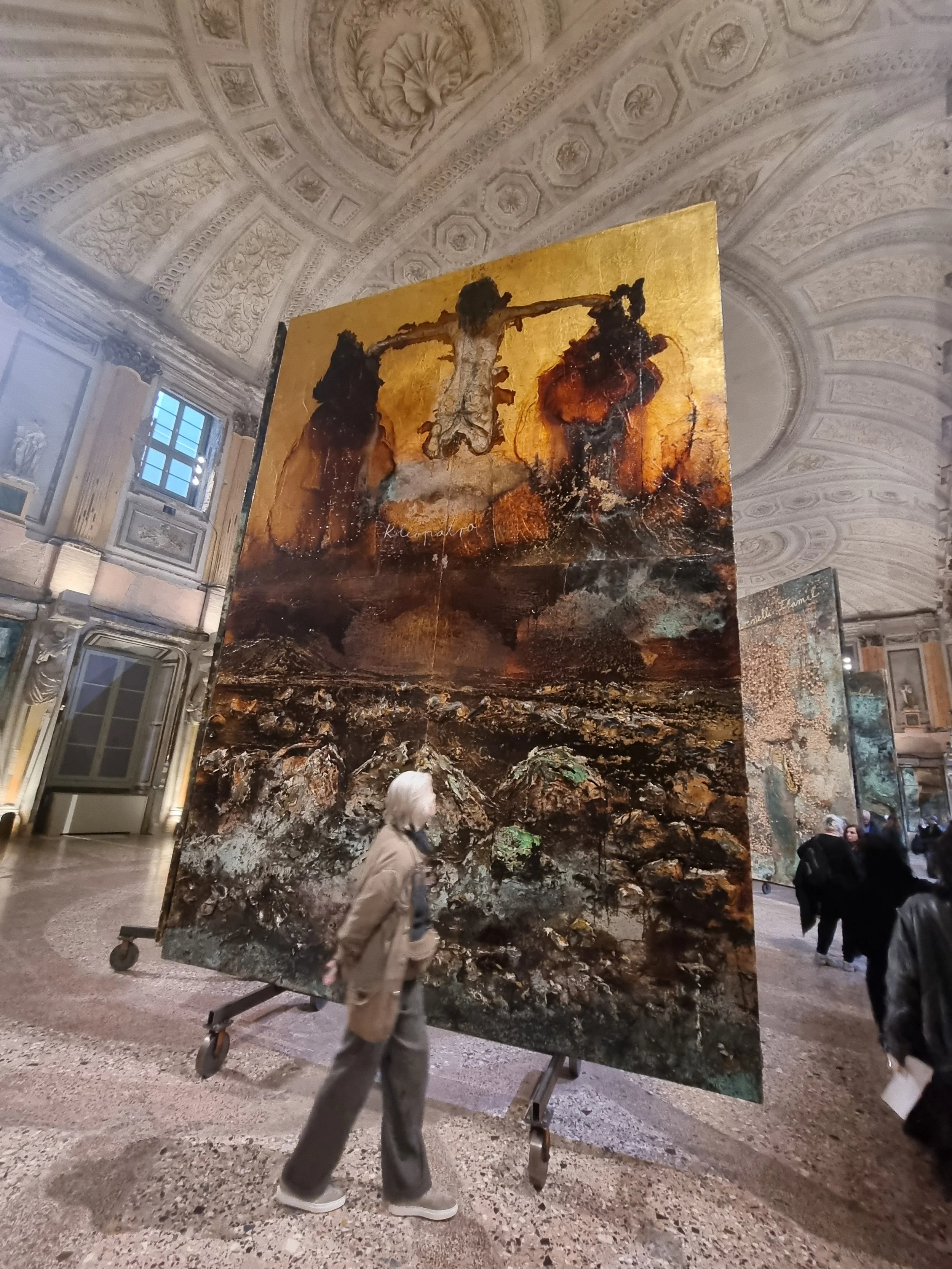
When Anselm Kiefer inaugurated I Sette Palazzi Celesti at Pirelli HangarBicocca in 2004, Milan crossed a threshold.
The city, long dominant in design and fashion, had struggled to position itself as a heavyweight in contemporary art. HangarBicocca — a vast former industrial plant — signalled a new phase: private capital investing in monumental art, post-industrial space reimagined as cultural infrastructure, and Milan entering the European circuit of immersive, large-scale installations alongside Tate Modern (2000) and Palais de Tokyo (2002).
Kiefer’s installation did not simply open a building, it reframed Milan’s artistic horizons.
Twenty-two years later, Kiefer returns — this time to the Sala delle Cariatidi at Palazzo Reale, under the umbrella of the Milano Cortina 2026 Cultural Olympiad. The setting could not be more symbolically charged: a war-scarred civic space in the historic heart of the city, activated at the precise moment Milan steps onto the Olympic stage.
The comparison is revealing and in this article, I discuss why.
2004: Industrial Transition as Cultural Driver
The 2004 moment was propelled by structural economic change. Milan’s industrial north was recalibrating. Corporations such as Pirelli invested in culture as part of urban repositioning. The driver was post-industrial transformation and private patronage.
HangarBicocca emerged as an institutional innovation — bold, large-scale, and internationally oriented — but fundamentally rooted in corporate vision and urban regeneration logics.
This large project gave Milan infrastructure.
2026: Olympic Momentum as Civic Catalyst
The Kiefer exhibition at Palazzo Reale unfolds within a different ecosystem. The driver here is not industrial conversion, but the Olympic hosting process itself.
As I my research has proven since 1999, there is substantial evidence [BG1] — historically and comparatively — that Olympic Cultural Olympiads generate accelerated cultural programming, institutional collaboration, and international visibility. London 2012 mobilised over 40,000 artists and redefined cultural participation at scale. Paris 2024 integrated thousands of labelled projects nationwide, embedding culture as public policy rather than side event.
The Cultural Olympiad of Milano 2026 (and the broader cultural strategy framework it is embedded within) is showing similar dynamics:
Major international exhibitions timed explicitly with the Games.
Stronger alignment between civic institutions and global cultural positioning.
A willingness to commission work of significant intellectual and spatial ambition.
The return of Kiefer — this time in Milan’s ceremonial civic palace rather than its industrial periphery — suggests not merely continuity, but escalation.
From Institutional Birth to Civic Assertion
If 2004 was about building contemporary art infrastructure, 2026 is about asserting cultural authority.
The Cultural Olympiad provides political cover and narrative urgency. Olympic deadlines compress decision-making. Global attention raises reputational stakes. The city is compelled to think at scale.
In this sense, the Cultural Olympiad in Milano – as was the case in Paris, in London, in Sydney 2000, Barcelona 1992 and even Los Angeles 1984 - is not decorative programming. It is functioning as a catalyst — accelerating partnerships, legitimising ambitious commissions, and situating Milan within a comparative framework of Olympic cultural capitals.
The difference is subtle but profound:
2004: Milan proving it could host monumental contemporary art.
2026: Milan demonstrating it can integrate art into a global mega-event narrative.
A 22-Year Arc
The often-repeated claim that Milan has not hosted a “truly iconic” exhibition in over two decades is telling. The benchmark frequently invoked is Kiefer’s 2004 intervention.
Now, the same artist marks another inflection point.
This is not coincidence. It is an arc.
Kiefer’s 2004 towers rose from an industrial void. His 2026 intervention enters a civic scarred palace, at a moment when Milan is projecting itself internationally not only as a design capital, but as a site of serious cultural reflection.
The Olympics have not created Milan’s artistic ambition. But they have amplified it, accelerated it, and reframed it.
The real legacy question for 2026 is not whether the Cultural Olympiad produces memorable events. It is whether the Olympic push embeds a lasting expectation that Milan must operate at this level of cultural confidence — long after the flame is extinguished.
If 2004 gave Milan a contemporary art space, 2026 may give it something more enduring: a recalibrated sense of cultural scale.